
Steacy Easton | Silenus on Pleasure Island
November 4, 2026–January 23, 2027
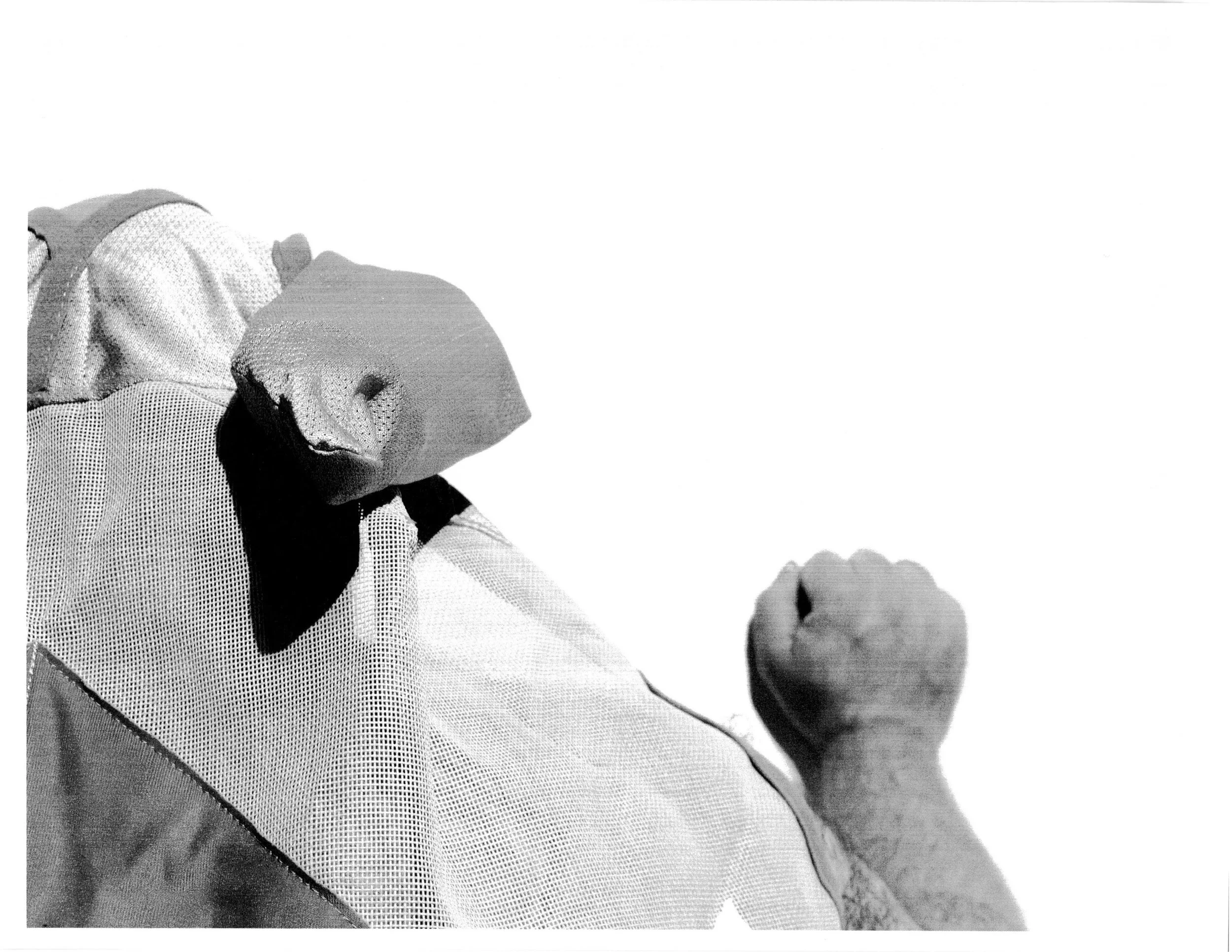
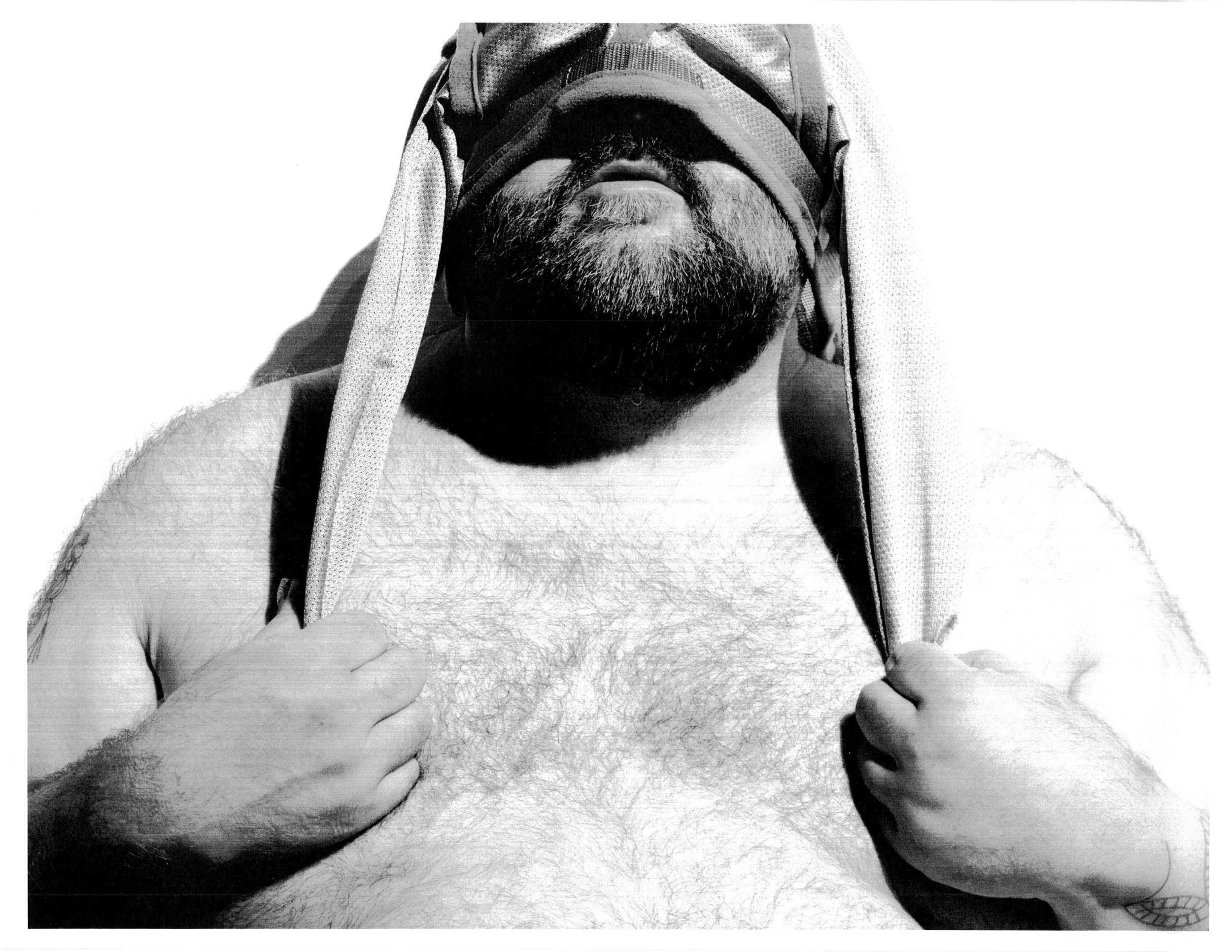
Reaching middle aged, and considering what it means to live in decay, without children or property, after decades of living a small, but hedonist life, Steacy Easton’s Silenius on Pleasure Island is a combination of performance documentation, conceptual project, and photographic installation in Latitude 53’s street-front windows and distributed throughout Edmonton. This set of images inherits a history of depictions of donkeys and humans, as a symbol of unbridled appetite, including Ruben’s The Drunken Silenus, Shakespeare’s A Midsummer’s Night Dream, Pinocchio, and the English photographer John Coplans. Easton’s work consists of ten images, five of them in a donkey mask, and five images of donkeys. The images have been reproduced by a commercial Xerox, emphasizing the decay of the material, and the decay of the body.
In an exchange with Hamilton Artist's Inc., this project is paired with a public work in Hamilton by amiskwacîwâskahikan-based Theo Donovan.
Artist's statement
I read Morgan Meis’ book on the Rubens painting The Drunken Silenius this year, and though I was frustrated by the work, I became obsessed with the painting. The rising and falling, the building and destruction which marks a Bachanal seems to be a young person’s game. Meis talks a lot about money, about real estate, in his book, and maybe the anxiety of age is the anxiety of what to do at the end of profligacy, but there is something more interesting here—the question of how to live a life of profligacy, of pleasure, when the body continues to fail, when belly and energy sag, when hair grows in some places and retreats in others; often the depictions of animalistic pleasure, are ones which ignore the possibility of aging.
Silenius was part of Bacchae’s retinue, and in this painting he is drunken; the whole painting thickens and bends to his fat body, unsteady because of drink and age. There are women, and men, a demonic looking caprine figure, a tiger, and a sleek goat. There is a cluster of children at his feet. The painting was successful enough that Anthony Van Dyck made prints thirty years after its original creation.
Silenius was in the cluster that surrounded Bacchus: satyrs (not fully human), donkeys, masked figures—the rot and the growth. Think about how alive and how dead they are—the mark of a pleasure both destructive and renewing. (There is a drawing in British Museum from a minor mannerist painter, where in the center of the composition, a drunken satyr, hooves dangling, above him a nude woman with a theatrical mask,and to his left a donkey, his snout almost hidden in the folds of a cluster of creatures wholly or partially passed out; there is a Roman statue now in the collection of Minneapolis, a nude woman laying prone on the back of a donkey; at the Met, a metal cup—Eros or Cupid astride a donkey’s head his tongue lolling.)
When I was a kid, the scariest scene in all of cinema was when the fox seduced Pinocchio into becoming a donkey—the transformation between donkey and human, both/and/neither, the desire for excess and the punishment, never being in control myself, and never knowing when the slip into unreason might occur, like the parental warning about a face staying that way when it is pulled into a grotesque shape; like hearing the ant and grasshopper motif over and over again. There is a moment of maturity in realising that one is the donkey, one is the grasshopper.
Reading A Midsummer Night's Dream for the first time, I wonder if my fear of becoming a donkey could be a virtue. Bottom becomes a donkey, but then he is noticed by Titania, Queen of the Fairies, who tells Bottom, she loves his “fair large ears.” My oversized body, my fat body, my unruly body, my body that is afraid of the shift and the thrust, a fairy, but not the fairy that is adorable, the fairy who only wants to be pretty, Does this act of transformation, finally allow for even a brief moment to have one’s unwanted body to be a virtue?
Goya mocks this in his print And So Was His Grandfather, with a donkey in human clothes looking at a book of donkey ancestry—a donkey with airs, with citations, with lineage is still a donkey.
I am still a donkey. I am closer to Silenius than Bacchus, but I am still a donkey.
When a donkey is aged out of usefulness, they are sent to the knackers; a donkey who can no longer work is useless. Sometimes a donkey who is lucky goes to a farm past Hamilton—this is not the euphemism for death, The Donkey Sanctuary is an actual farm, nearer to the unfortunately named Puslinch. There are donkeys there, who apparently did not work well with others, or were thought to be too old to work, or who come from unfortunate lives and now spend the rest of their days in gently rolling fields, being taken care of. Sometimes they have masks on to prevent flies and other creatures from aggravating them. They rest in each other’s bodies, with the masks; the intervention does not prevent a good life, an ending life.
John Coplan was a curator and then when he hit 60, he spent twenty years photographing his aging body. He rarely shows his face, but the belly, the arms, and the back to indicate a kind of truth telling and masking—the creature exuding a kind of Silenius energy.
Owning my body, no longer being fearful of my flesh, returning to the land that I grew up in after the death of my father, who died in chaos and indignity; watching my mother dying, wondering about the ancestry of donkey as allegory, wondering about the irony of masking and unmasking. Their own queen of fairies, these photocopies function as a dual site—at Latitude 53, in the window, like a reflection, and distributed throughout the city. In the Dionysian ritual the bodies disintegrate, almost liquify, and then restore; in the second half of my life, this work becomes like that ritual—of memory, of liberation, and ambiguity. My fat body, my Autistic body, my trans body, stripped and with a mask like a crown, outsized and no longer afraid; I will remake Pleasure Island as a refuge for all outlaws, a sanctuary not bound by the land, that allows for the possibilities of dissolution.
Steacy Easton (they/them) is a writer and artist, living currently in Hamilton, Ontario. They have written on gender, sexuality, and country music for publications including Slate, NPR, and The Atlantic Online. They have written three books, Why Tammy Wynette Matters for the University of Texas; Daddy Lessons for Coachhouse, and a volume on Dolly Parton for the 33 ⅓ series for Bloomsbury. Their visual work has been shown in Edmonton, Hamilton, Montreal. Toronto, and New York., They have been collected by a number of University collections and museums, including the Art Gallery of Alberta, the Library of the National Gallery, and the Art Gallery of Hamilton, They were artist in residence for Martha Street Studios in Winnipeg, 2022; and had a residency at Factory Media in Hamilton, in 2025, and a residency at Banff in 2026. Their upcoming work includes work at Tale of the Tubs, Rotterdam.
Steacy Easton, ABD, is also a scholar about Autism, and an Autistic Scholar, combining academic and artistic practice for twenty plus years. Their writing on Autism has included the 2013 essay Autism: An Accidental Abecedarium, for Kader Koli, and is considered an important document in Autistic rhetoric. They have also presented on Autism/rhetoric for conferences throughout North America. They have been research assistants on projects about Neurodiversity and the Arts, plus an ongoing SSHRC funded project on Elopement. Their art work about Autism has been collected or performed in galleries in Halifax, Halifax, Montreal, Toronto, Rotterdam, and Edmonton.